
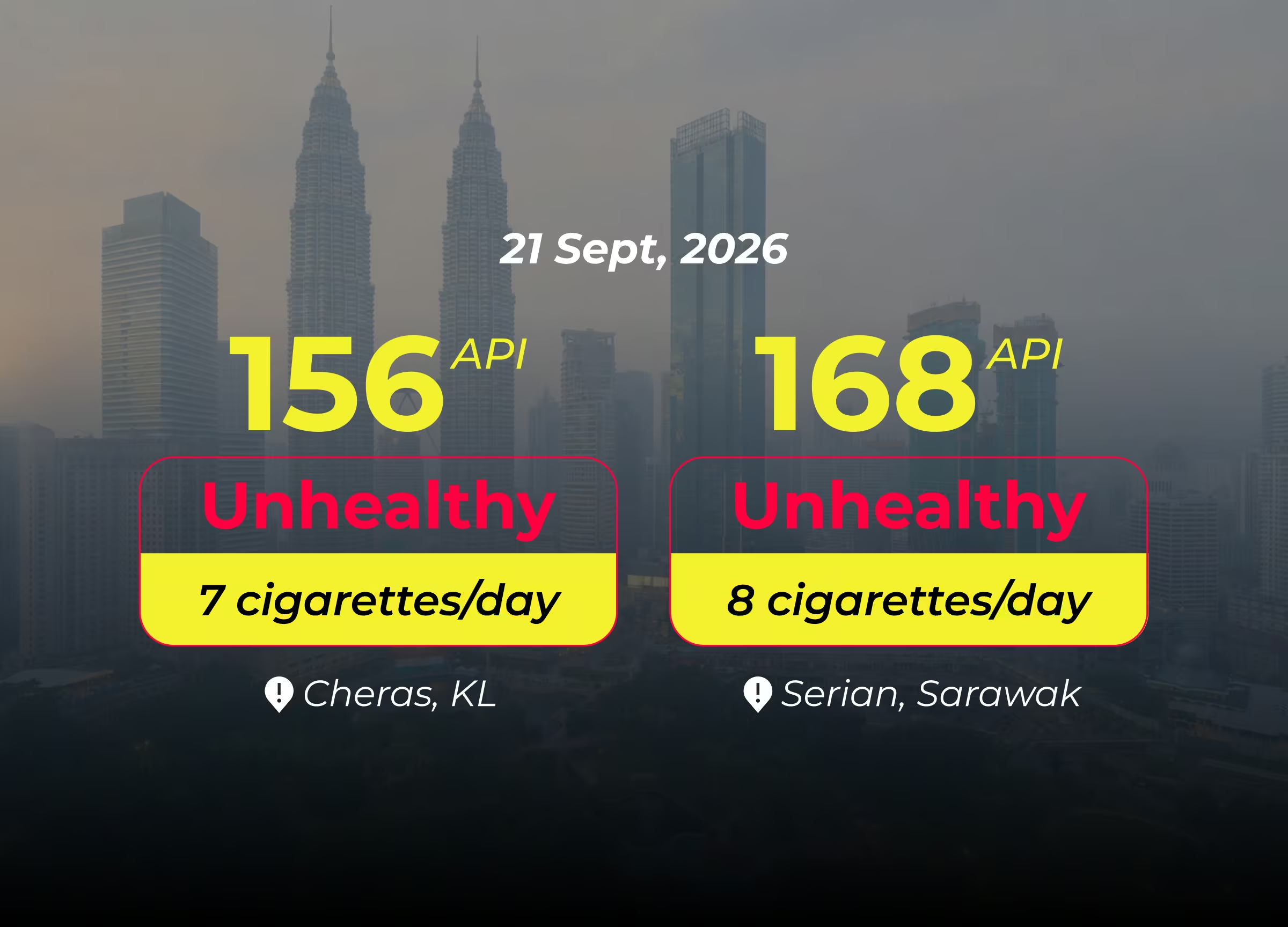
Haze Malaysia is smoke in your lungs, not a grey sky. This week the air pollution index in many towns is unhealthy. Sarawak has had the worst of it. Putrajaya, the Klang Valley, Negeri Sembilan, Johor and Melaka have all seen API Malaysia readings above 100. Watch the IPU Malaysia number for the station nearest you. That figure is almost always PM2.5 from jerebu.
What is the API in Malaysia this week?
As of 20–21 September 2026, many Department of Environment stations logged unhealthy air (API 101–200). Serian, Kapit, Kuching, Samarahan and Sri Aman in Sarawak sat in the 160s to 180s. Putrajaya, Nilai, Shah Alam, Cheras, Seremban and several Johor and Melaka sites crossed 150.
Earlier this month Serian hit API 521. The Yang di-Pertuan Agong consented to a haze emergency there, the first since Muar and Ledang in 2013. It lasted three days. Schools in Sarawak stayed closed longer.
API / IPU Malaysia bands
Outdoor school activity usually stops at 101. Schools close when the air pollution index reaches 200.
| API (IPU) | Status |
|---|---|
| 0–50 | Good |
| 51–100 | Moderate |
| 101–200 | Unhealthy |
| 201–300 | Very unhealthy |
| 301 and above | Hazardous |
How many cigarettes is this week’s air pollution?
During jerebu the reported API Malaysia figure is almost always the PM2.5 sub-index. DOE’s formula for the unhealthy band is:
API = 1.3218 × (PM2.5 − 75.5) + 101
so PM2.5 (µg/m³) = 75.5 + (API − 101) ÷ 1.3218
A common comparison treats 22 µg/m³ of PM2.5 over 24 hours as roughly one cigarette’s long-term burden. That is an upper estimate if you breathe that air all day outdoors.
| Level | API | Est. PM2.5 | Upper estimate, cigarettes/day |
|---|---|---|---|
| Start of unhealthy | 101 | 75.5 µg/m³ | ~3.4 |
| Cheras / Putrajaya this week | 156–157 | ~117 µg/m³ | ~5.3 |
| Kapit (among the highest on 21 Sept) | 172 | ~129 µg/m³ | ~5.9 |
| Very unhealthy line | 200 | ~150 µg/m³ | ~6.8 |
| Serian emergency peak | 521 | ~500+ µg/m³ | ~23 |
Stay indoors with the windows shut and the real dose falls. Children, pregnant women, older people and anyone with heart or lung disease get hurt at lower numbers than healthy adults.
Why we have haze in Malaysia
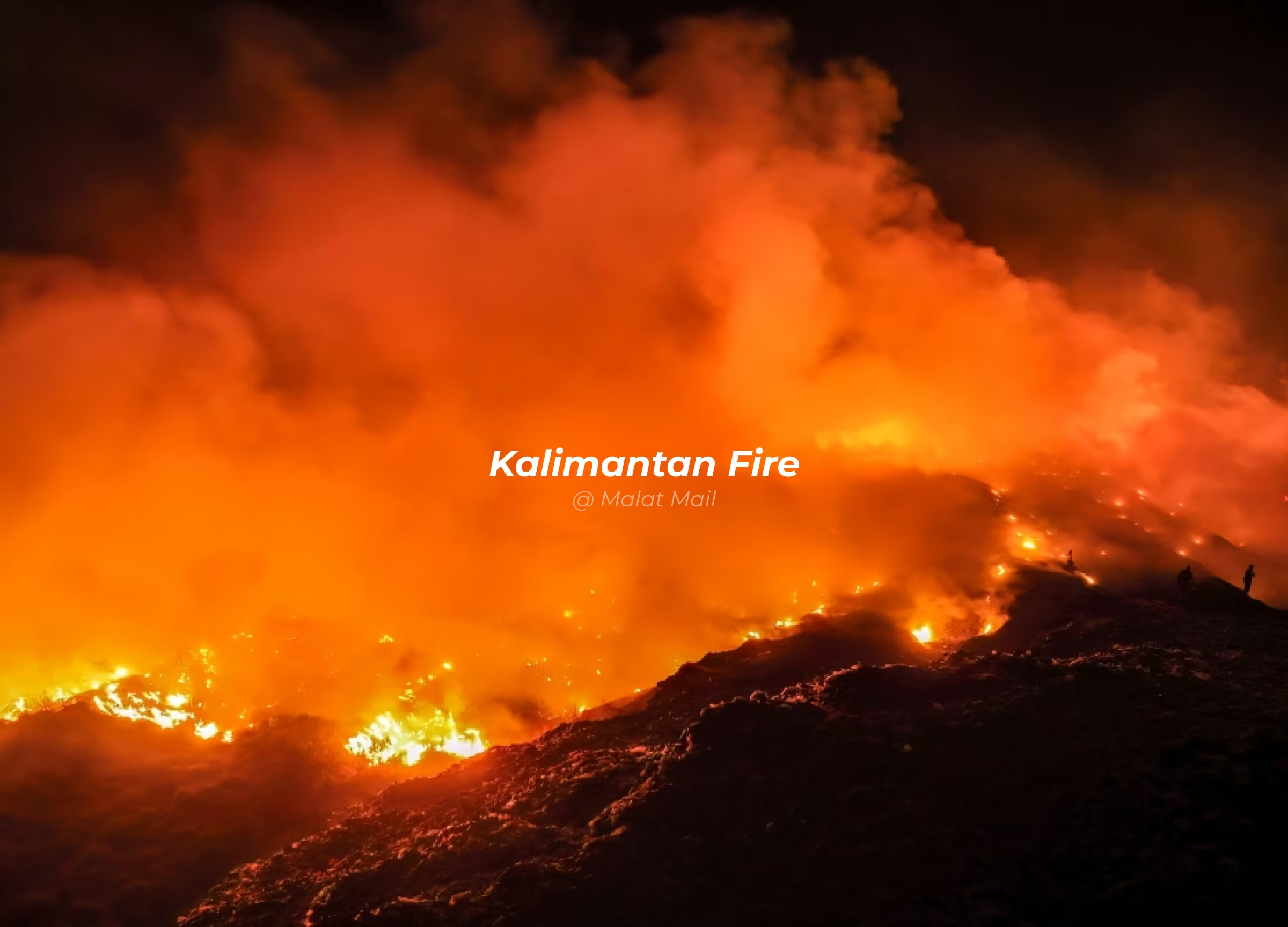
Most of the smoke is not made by Malaysia. During the southwest monsoon, winds carry it across from forest and peat fires in Kalimantan and Sumatra. Fire is still used to clear land because it is cheap, for oil palm, pulp and small plots alike. Once peat is drained it dries out, catches easily and can burn under the ground for weeks. A long dry spell or El Niño only makes the same Kalimantan fire run farther. Local open burning and city exhaust add to the dust, but they do not explain a jerebu that hits Johor, Sarawak and the Klang Valley in the same week. That stream of smoke originated on the other side of the border and drifted with the wind.
What is PM2.5, and what it does in your blood
PM2.5 refers to fine particulate matter in the air—specifically, particles with a diameter of 2.5 micrometers or smaller. A human hair is about 50 to 70 micrometres wide, so these bits are many times thinner than that. During haze Malaysia episodes they are mostly smoke and ash from a Kalimantan fire, mixed with whatever the wind picks up on the way.
They do not stop in the nose or throat. They reach the deepest part of the lung. Some pass into the bloodstream. In the blood they set off inflammation. Vessels stiffen, blood pressure rises, clots form more easily. That is why haze days track with more heart attacks, strokes and asthma attacks, not only coughs. These particles belong to the same class of carcinogens as tobacco smoke. Relative to their body size, fetuses and young children inhale higher doses.
WHO’s safe 24-hour mark is 15 µg/m³. An API Malaysia of 101 already means about 75 µg/m³, five times that line. That is why IPU Malaysia jumps when jerebu arrives. The index is measuring this dust, not the smell.
How to check API Malaysia
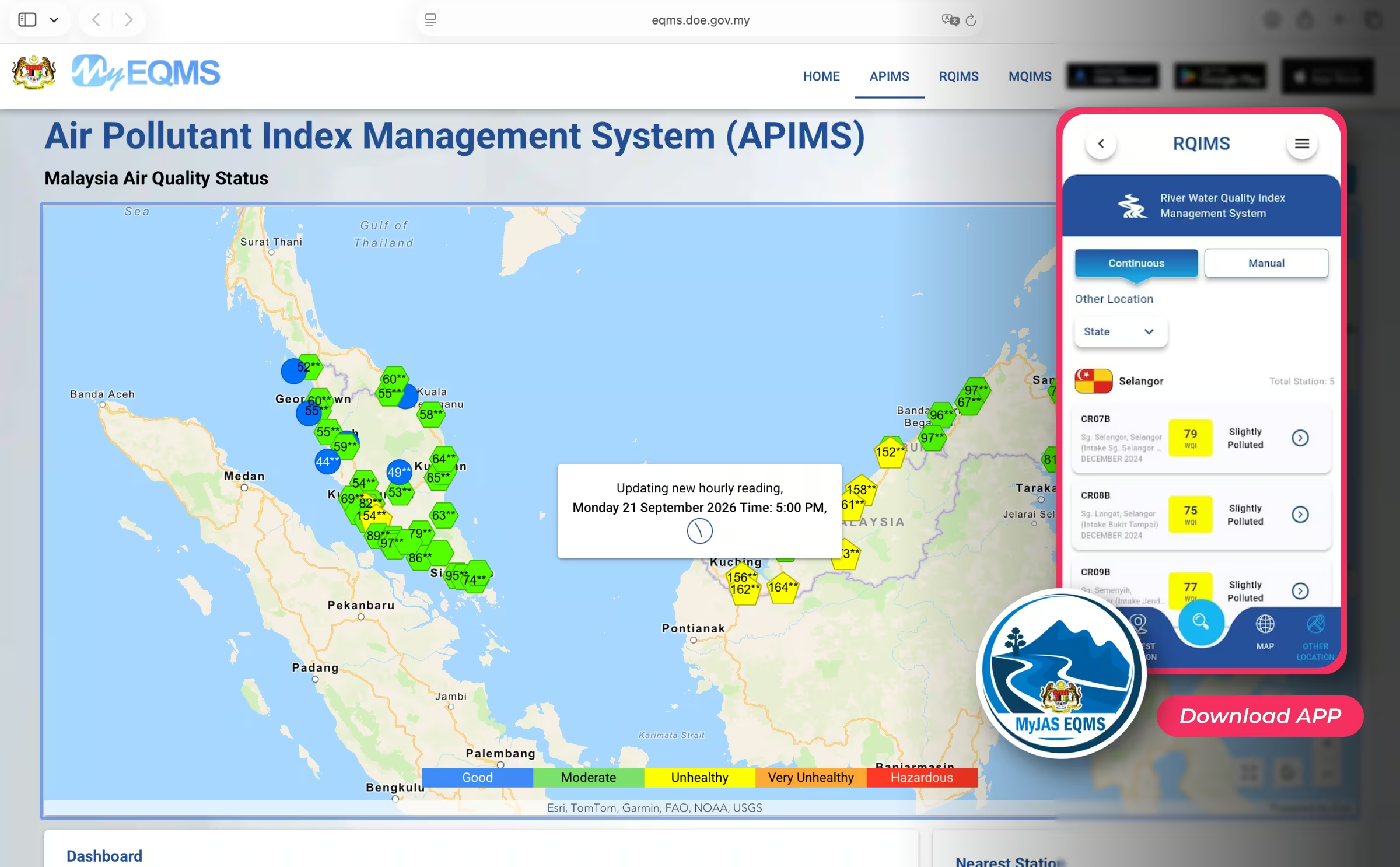
Use the Department of Environment. Other apps often print a different scale.
Website: eqms.doe.gov.my/APIMS/main
App: MyJAS EQMS (iOS and Google Play)
Readings refresh every hour. The PM2.5 number behind IPU Malaysia is a 24-hour running average, so a sudden night spike can look milder on the index than the air outside feels.
How to protect yourself
-
- Stay inside when API Malaysia is 101 or above. Shut windows.
- Run a HEPA purifier. Ozone “ionisers” do not cut PM2.5.
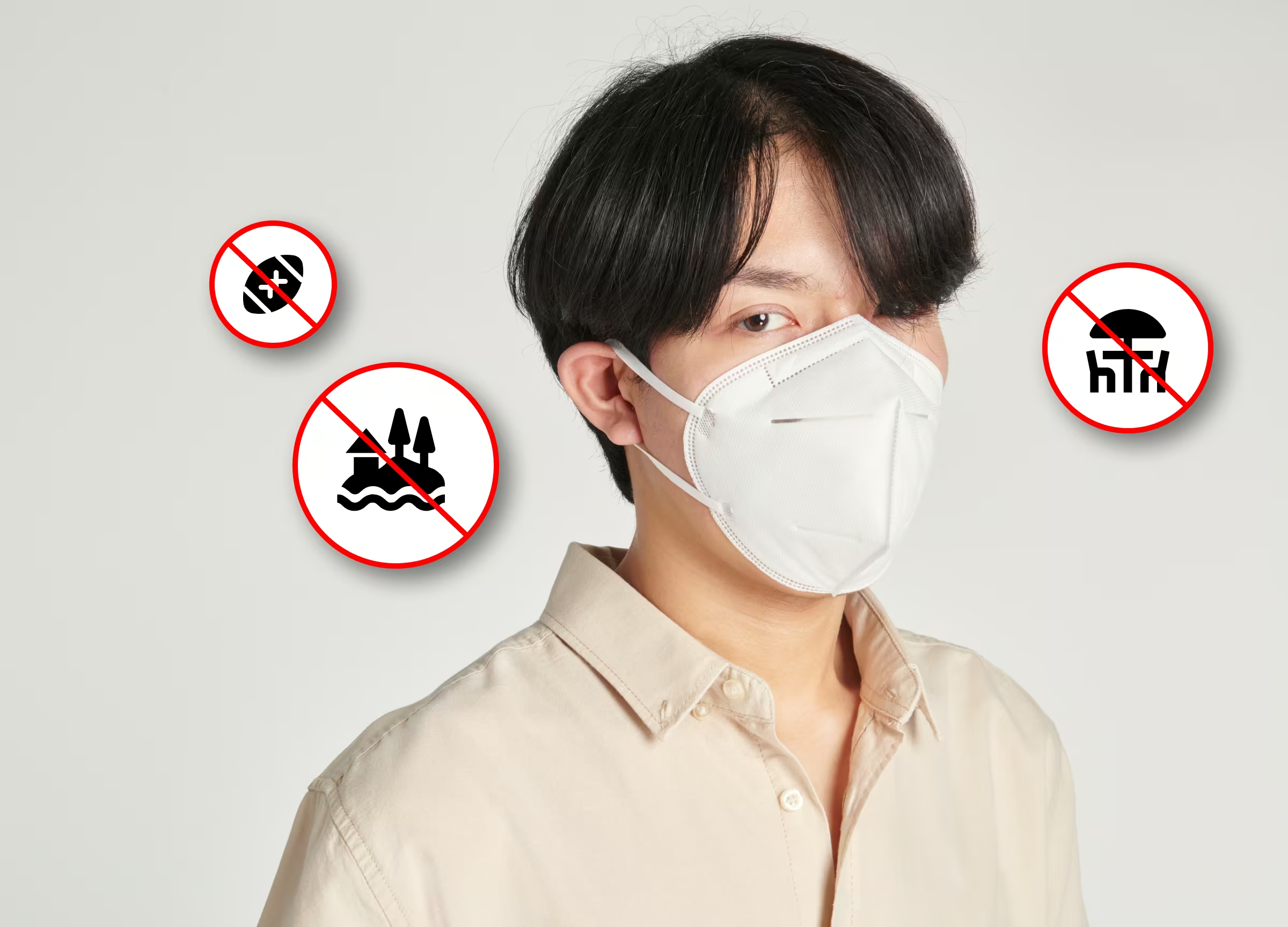
- Outside: a fitted N95 or KN95. Cloth and surgical masks leak. N95s are hard work to breathe through. They fit children poorly and are not meant for long wear in pregnancy.
- Drop outdoor sport.
- Do not smoke. Drink water. (Keep inhalers close if you have asthma.)
- Houseplants cannot purify this kind of air.
What Malaysia and Indonesia are doing, and how this stops
This month Deputy Prime Minister Ahmad Zahid met President Prabowo in Jakarta. Indonesia accepted Malaysian help against the Kalimantan fire: a Bombardier CL-415 water bomber, three helicopters and about 52 officers from NADMA, APMM and the RMAF. Cloud seeding along the border was already approved. Prabowo said there were still more than 1,400 hotspots in Kalimantan and that 95 companies had been pulled up for open burning.
The two sides are discussing prevention, not compensation. ASEAN currently continues to operate based on the 2002 ASEAN Agreement on Transboundary Haze Pollution. Putting this week’s fires out does not end the cycle. That needs wet peat left wet, companies held to their drainage rules, and no fire used as the cheapest way to clear land. Until that holds, the monsoon will keep delivering Kalimantan smoke into Malaysian air.
Please check Malaysia’s API (Air Pollutant Index) before heading out. If the reading exceeds 100, consider the air to be polluted—because it is.
A personal view
To me, the haze problem plaguing Kuala Lumpur, and indeed all of Malaysia, feels deeply unfair. It is the Malaysian people who bear the health costs: coughing, school closures, and children confined indoors, while the elderly and asthma sufferers face genuine health risks. Yet a significant portion of the problem originates across the border, stemming from fires in the peatlands and plantations of Indonesia. That is precisely what is so frustrating. No matter how much effort we make in Kuala Lumpur, whether by wearing masks, using air purifiers, or staying indoors, we cannot address the root cause.
What I find hardest to accept is that this is a predictable, recurring disaster. It is not a sudden, unforeseen accident. It arrives with the dry season and worsens during El Niño years, yet the region reacts to it every time as if it were a new phenomenon. Even though everyone anticipates the problem, it remains unresolved.
This is a sensitive topic, and many Malaysians hold differing views on it. The above reflects only my personal opinion. What is your take? Do you view it primarily as a health issue, or as something else entirely?