
Almost every Malaysian household has heard of ASNB, and a good number of us have an account sitting somewhere with RM200 in it from when a parent opened one years ago. Fewer people can actually explain what the funds do, why there are three different ASM funds, or why the units keep showing as unavailable when you try to buy.
This guide covers the basics properly: what ASNB is, how ASM, ASM 2 Wawasan and ASM 3 differ, what they have paid out over the past few years, and the practical stuff like which apps let you buy units and how old you need to be to open an account.
What is ASNB?
ASNB stands for Amanah Saham Nasional Berhad. It is the unit trust management company wholly owned by Permodalan Nasional Berhad (PNB), and it has been around since 22 May 1979.
The distinction matters because people mix the two up. PNB is the investment institution that owns and sponsors the funds. ASNB is the arm that issues the units, sells them to you, and administers your account. When you read a dividend announcement, it is usually PNB issuing the statement about a fund that ASNB manages.
ASNB currently manages 18 unit trust funds with roughly 280 billion units in circulation across more than 15 million accounts. It runs 32 branch offices and works with over 2,600 agents nationwide, including Affin Bank, AmBank, Bank Islam, Bank Muamalat, Bank Simpanan Nasional, CIMB Bank, Hong Leong Bank, Maybank, RHB Bank and Pos Malaysia.
Fixed price versus variable price
Every ASNB fund falls into one of two camps, and this is the single most useful thing to understand before you invest anything.
Fixed price funds are permanently priced at RM1.00 per unit. You buy at RM1.00 and you redeem at RM1.00. The unit price does not move with the market, so your entire return comes from the annual income distribution, which gets reinvested as extra units unless you withdraw it. There are six of these: ASB, ASB 2 and ASB 3 Didik for Bumiputera investors, and ASM, ASM 2 Wawasan and ASM 3 for all Malaysians.
Variable price funds are the ASN series. Their price moves daily based on the fund’s net asset value, they carry a sales charge, and your capital can go down as well as up. They are ordinary unit trusts in the way most people understand the term.
Worth saying plainly: the fixed price funds have held RM1.00 since they launched, but the prospectus states they are not capital guaranteed or capital protected. That track record is not a legal promise. Treat it as a very strong history rather than a guarantee.

Amanah Saham Malaysia: ASM, ASM 2 Wawasan and ASM 3
The ASM series is open to every Malaysian citizen regardless of race. This is the practical alternative for non-Bumiputera investors who cannot buy into the ASB funds.
All three work the same way. RM1.00 per unit, no sales charge, minimum initial investment of RM10, distributions reinvested automatically. Under the hood they are mixed asset funds that can hold up to 90% in equities, with at least 5% kept in cash or liquid assets.
So why three funds? Mostly history, and the fact that demand kept outrunning supply.
| ASM | ASM 2 Wawasan | ASM 3 | |
|---|---|---|---|
| Launched | 20 April 2000 | 1996 | 5 August 2009 |
| Original name | ASM | Amanah Saham Wawasan 2020 | Amanah Saham 1Malaysia |
| Renamed | Not renamed | October 2018 | October 2018 |
| Financial year end | 31 March | 31 August | 30 September |
| Latest distribution | 5.00 sen (FY2026) | 4.75 sen (FY2025) | 4.75 sen (FY2025) |
| Eligibility | All Malaysians | All Malaysians | All Malaysians |
| Minimum initial | RM10 | RM10 | RM10 |
ASM is the original and the largest of the three. As at March 2026 it had 786,088 unitholders holding 31.22 billion units.
ASM 2 Wawasan started life in 1996 as Amanah Saham Wawasan 2020, the fund tied to the old Vision 2020 branding. It was renamed in October 2018 when ASNB tidied up its fund names. It is aimed at investors who want regular income distributions, and as at August 2025 it had 983,505 unitholders across 25.5 billion units, making it the most widely held of the three by account count.
ASM 3 was launched in August 2009 as Amanah Saham 1Malaysia, and was renamed alongside ASM 2 Wawasan in 2018. It leans towards steady income while preserving capital over a longer horizon. As at September 2025 it had 717,446 unitholders and 19.16 billion units.
If you are wondering which one to pick, the honest answer is that the differences are small. The staggered financial year ends are the one genuinely useful distinction. Spread money across all three and you receive a distribution in April, September and October instead of once a year, which helps if you like seeing income arrive more than once.

ASM dividend rates and payout dates
Distributions are quoted in sen per unit. Because the unit price is always RM1.00, 5.00 sen per unit works out to a 5.00% return for that financial year.
| Financial year | ASM | ASM 2 Wawasan | ASM 3 |
|---|---|---|---|
| 2019 | 5.50 sen | 5.00 sen | 5.00 sen |
| 2020 | 4.25 sen | 4.00 sen | 4.00 sen |
| 2021 | 4.00 sen | 4.00 sen | 4.00 sen |
| 2022 | 4.00 sen | 3.75 sen | 3.75 sen |
| 2023 | 4.50 sen | 4.50 sen | 4.50 sen |
| 2024 | 4.75 sen | 4.75 sen | 4.75 sen |
| 2025 | 5.00 sen | 4.75 sen | 4.75 sen |
| 2026 | 5.00 sen | To be declared | To be declared |
The pattern is easy to read. Rates dropped sharply in 2020 and bottomed out around 2022, then climbed back. ASM has recovered furthest, holding 5.00 sen for two years running.
For the financial year ended 31 March 2026, ASNB declared 5.00 sen per unit for ASM, a total payout of RM1.54 billion to 786,088 unitholders. That beat the Maybank 12-month fixed deposit benchmark of 2.18% by 282 basis points.
ASM 2 Wawasan paid 4.75 sen per unit for the year ended 31 August 2025, RM1.18 billion in total, beating the 2.46% average 12-month fixed deposit rate by 229 basis points.
ASM 3 paid 4.75 sen per unit for the year ended 30 September 2025, a payout of RM896.01 million, beating its 2.40% fixed deposit benchmark by 235 basis points.
When the money lands
Each fund follows its own financial year, so the payouts are staggered:
ASM closes its books on 31 March. The declaration usually comes in the last week of March and the units are credited on 1 April.
ASM 2 Wawasan closes on 31 August, with the announcement in late August and units credited on 1 September.
ASM 3 closes on 30 September, announced in the last days of September and credited on 1 October.
Expect a short blackout around each of those dates. ASNB suspends transactions on the relevant fund for a few days while it runs the calculation. For ASM in 2026, transactions were frozen from 27 to 31 March and resumed on 1 April. For ASM 2 Wawasan in 2025, the freeze ran 30 to 31 August, with myASNB reopening on 1 September and branches on 2 September.
How your dividend is actually calculated
This trips up a lot of people. The distribution is not based on your closing balance. It is calculated on your average minimum monthly balance across the fund’s financial year.
In practice that means money you put in early in the financial year earns for more months than money you dump in the week before the year ends. If you deposit RM10,000 in February for a fund whose year closes on 31 March, most of your balance only counted for one or two months out of twelve. The distribution will reflect that, and every year a fresh batch of investors is surprised by it.
The other half of the rule is the reverse: pulling money out mid month drags down that month’s minimum, which drags down the average. Frequent in and out withdrawals quietly cost you.
Class A and Class B: the 2026 zakat change
This one is new enough that most guides have not caught up yet. Effective 25 May 2026, ASNB restructured all six fixed price funds into a multi class format.
Every existing unitholder, Muslim and non-Muslim, was automatically placed in Class A. Class A receives the income distribution in full with no zakat deducted, exactly as before, so if you did nothing, nothing changed for you.
Class B is optional and only open to Muslim unitholders. Under Class B, ASNB deducts zakat from your income distribution and pays it to the relevant state zakat centre on your behalf, within five working days of the fund’s financial year end. As of mid 2026 only three state centres were live for this: PPZ-MAIWP for Wilayah Persekutuan, MAIDAM for Terengganu and PKZ Pahang.
One detail deserves attention before anyone opts in. The switch is one way. Once you move into Class B, you cannot revert to Class A.
The myASNB app and ASNB online
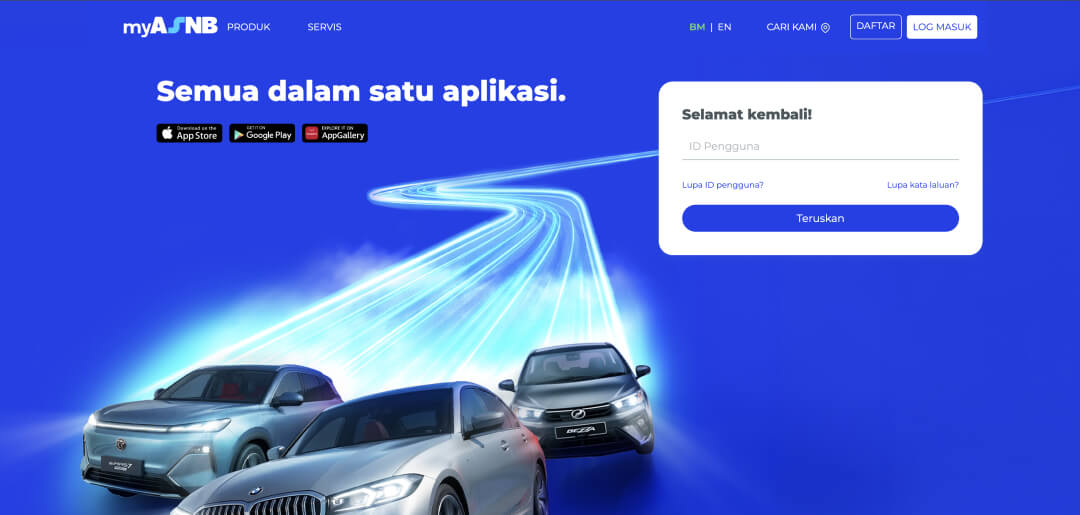
myASNB is the digital platform for everything ASNB related, available as a mobile app and as a web portal at myasnb.com.my. It replaced the old passbook system, which is why nobody hands you a little book anymore.
Through myASNB you can register a new account, check your balance, buy additional units, redeem units, view your dividend history and update your details. There is no platform fee to register.
For ASNB login, you need an active account registered with myASNB, your user ID and password, and access to your registered mobile number for the OTP. If you are getting locked out, the usual culprits are an outdated app, an expired TAC or a phone number that was never updated after you changed it. The last one has to be fixed at a branch or agent counter.
The app also supports push authentication, which is more reliable than waiting for an SMS that may never arrive.
Which apps and banks can you buy ASM units from?
You are not limited to the myASNB app. Several banks and one e-wallet have integrated ASNB investment features, which is handy when units are released and everyone piles onto the same platform at once.
Internet and mobile banking channels include Maybank2u and the MAE app, CIMB Clicks, RHB Now, AffinOnline and HLB Connect. Maybank’s ASNB transfer service operates from 2.00am to 9.00pm daily, so it is not a true 24 hour channel.
On the e-wallet side, Touch ‘n Go eWallet supports ASNB investment. The minimum additional investment through TnG is RM10, slightly higher than the RM1 minimum on most other channels.
Over the counter, you can transact at any of the 32 ASNB branches, at agent bank branches, or at Pos Malaysia outlets.
One practical note. When a fresh batch of units is released, availability is first come first served and the myASNB app is usually the fastest route. Bank apps sometimes lag behind by a few minutes, which is enough to matter when a popular fund reopens.

How to open an ASNB account
For adults, the whole thing is done from your phone in about fifteen minutes.
Download the myASNB app from the App Store, Google Play or AppGallery, then choose to register a new account. Fill in your personal details, making sure your name and IC number match your MyKad exactly. You will then run through eKYC: scan the front and back of your MyKad with your phone camera, then take a selfie in decent lighting so the system can match your face to your IC photo.
An OTP goes to your mobile number for verification. After that you set your user ID, password and security questions, link a bank account in your own name for FPX transfers, and make your first purchase. The minimum initial investment is RM10.
If you would rather do it in person, bring your MyKad to any ASNB branch or agent bank counter. Some situations still require a counter visit, such as updating a mobile number you no longer have access to.
What age can you open an ASNB account?
For your own account, you must be a Malaysian citizen aged 18 or above. That is the threshold for an adult account and for registering directly on myASNB.
Children under 18 can still hold units, but the account is opened and managed by a parent or legal guardian who is themselves 18 or older. You will need the child’s MyKid or birth certificate, or their MyKad if they are 12 or above, plus the guardian’s MyKad. The minimum initial investment is the same RM10.
These minor accounts fall under ASNB Bijak, the programme aimed at young investors, which gives access to ASB or ASM 3 depending on eligibility along with campaign rewards. ASM 3 units were made available again for ASNB Bijak accounts from 12 May 2026, which is worth knowing because minor accounts sometimes have allocation when adult accounts do not.
Finding an ASNB branch near you
If you are searching for an ASNB branch near me, the branch locator on asnb.com.my is the reliable source. There are 32 ASNB branches, with the larger states covered by multiple offices in places like Shah Alam, Johor Bahru, Ipoh, Seremban, Melaka, Alor Setar, Kuching, Miri and Kota Kinabalu.
Beyond the branches, the agent network is far wider. Any Maybank, CIMB, RHB, Affin Bank, AmBank, Bank Islam, Bank Muamalat, Bank Simpanan Nasional or Hong Leong Bank branch acting as an ASNB agent can handle most transactions, as can Pos Malaysia counters. For a straightforward withdrawal or balance check, your nearest bank branch is usually faster than travelling to an ASNB office.
The catch nobody mentions in the ads
ASM units are frequently unavailable, and this is the most common frustration among non-Bumiputera investors.
Non-Bumiputera purchases in the ASM funds run on an allocation system. When that allocation is exhausted, units only become available again when existing holders redeem or when ASNB releases a fresh tranche. So you can have the money ready, an active account, and still be told there are no units to buy.
Releases do happen, and they are worth watching for. In July 2025 ASNB released 1.18 billion units across ASM, ASM 2 Wawasan and ASM 3 with no subscription limit. There have also been campaigns targeted at newcomers, including an allocation of ASM 3 units set aside for new customers registering through the myASNB app, capped at RM10,000 per person.
The practical advice is simple. Open your account before you need it, keep a bank account linked and ready, and follow ASNB’s official social media channels so you hear about a release on day one rather than day three.
Frequently asked questions
Is ASM the same as ASB?
No. Both are fixed price funds at RM1.00 per unit managed by ASNB, but ASB, ASB 2 and ASB 3 Didik are restricted to Bumiputera investors. ASM, ASM 2 Wawasan and ASM 3 are open to all Malaysian citizens.
Can non-Bumiputera Malaysians invest in ASM?
Yes. All three ASM funds accept any Malaysian citizen regardless of race. The limitation is unit availability rather than eligibility.
What is the difference between ASM, ASM 2 and ASM 3?
They share the same fixed RM1.00 price, the same RM10 minimum and a similar investment approach. The clearest difference is the financial year end, which determines when you get paid: 31 March for ASM, 31 August for ASM 2 Wawasan and 30 September for ASM 3.
When is the ASM dividend paid?
ASM distributions are credited on 1 April, ASM 2 Wawasan on 1 September and ASM 3 on 1 October. The rate is announced in the final week of the preceding month, and transactions on that fund are suspended for a few days beforehand.
Do I need to pay tax on ASNB dividends?
No. Income distributions from ASNB unit trust funds are tax exempt and do not need to be declared in your LHDN e-Filing.
Can I lose money in ASM?
The unit price has been held at RM1.00 since launch, but the prospectus states clearly that these funds are not capital guaranteed or capital protected. The distribution rate is also not guaranteed and has ranged from 3.75 sen to 5.50 sen over the past eight years.
How much do I need to start?
RM10 for your first investment. After that, additional investments can be as low as RM1 on most channels, or RM10 through Touch ‘n Go eWallet.
Can I withdraw anytime?
Yes, there is no lock in period and no cooling off restriction. The minimum redemption is RM100 per transaction, and online redemptions are capped at 2,000 units per month, so larger withdrawals need to go through a branch or agent.
Can I use my EPF savings to invest?
Partly. Under the EPF Members Investment Scheme, ASM 2 Wawasan and ASM 3 are eligible, along with ASB 2, ASB 3 Didik and several ASN funds. ASM itself is not on the EPF-MIS list, and neither is ASB. The amount you can transfer is calculated as your Account 1 balance minus Basic Savings, multiplied by 30%, with a typical minimum of RM1,000. You can do it through i-Invest in your EPF i-Akaun.
Why do the ASM units always show as unavailable?
Non-Bumiputera allocation in the ASM funds is capped. Once it fills up, no new units can be bought until existing investors redeem or ASNB releases a new tranche.
Can I open an ASNB account for my child?
Yes. A parent or legal guardian aged 18 or above can open a minor account for a child under 18 using the child’s MyKid or birth certificate. The account falls under the ASNB Bijak programme and the RM10 minimum applies.
How do I check the ASNB price today?
For fixed price funds there is nothing to check. ASB, ASB 2, ASB 3 Didik, ASM, ASM 2 Wawasan and ASM 3 are always RM1.00 per unit. Only the variable price ASN funds have a daily net asset value, which you can view on the myASNB portal or app.
Before you invest
The ASM funds are a reasonable place for money you want to keep stable while earning more than a fixed deposit. They are not going to make anyone rich, and the recovery from the 2022 low has been gradual rather than dramatic. Anyone treating a 5% distribution as a floor should look at the 2020 to 2022 stretch first.
Read the prospectus and the product highlights sheet on asnb.com.my before committing money. This article is general information, not financial advice, and past distribution rates say nothing definite about future ones.